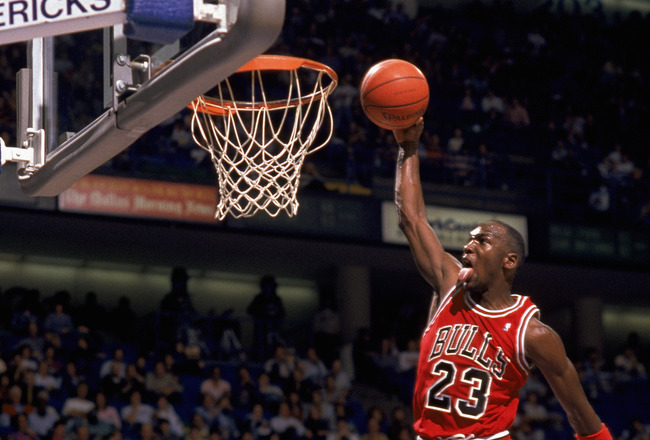
Do I Want To
"Be Like Mike!"?
Athletes at the collegiate and professional levels face endless pressures of attention, fame and ensuing temptation, and are looked to as role models and influences by younger athletes. One might be able to infer this on their own,
but studies show that athletes are more influential in the lives of children than faith leaders. (Thankfully?) I never experienced this myself in college, but was able to witness this pressure among athletes in college and as a coach. These pressures were no more apparent than during this past weekend in the events surrounding the NBA All Star Game.
I had the opportunity to volunteer at the NBA All Star Game Jam Session, an experience for fans, where I assisted in facilitating some on-court sessions and clinics. While I didn’t become friends with any NBA stars, or have any meaningful conversations with them (although I did rebound for WNBA player
Candice Wiggins), I was able to be close to some NBA players (Andre Drummond from the Detroit Pistons, Russell Westbrook from the Oklahoma City Thunder and Michael Kidd-Gilchrist from the Charlotte Bobcats stopped by), noticing that even though they had all the luxuries and attention they could ever ask for, they still seemed somewhat uncomfortable with all their attention. It was interesting being close enough to pay close attention to their interactions with fans, children, and the NBA representatives who seemed to guide their every move. Since being around athletes has been normal to me, I have become somewhat desensitized to the aura surrounding professional athletes (with the exception of the time I saw Michael Phelps in a store near the Galleria).

The pressure of making promotional appearances and signing autographs on a daily basis, completely driven by us as fans, must take its toll on athletes. We spectators forget that athletes are just like any of us. They have families. They have friends. They have interests other than sports. They have personal matters that demand their attention. And they desire relationships. But the incessant stream of photo and autograph requests cannot breed deeper relationships, and are probably just viewed as distractions.
I think this discomfort exists within athletes because they do not find their athletic or commercial accomplishments to be completely satisfying. These are men (and sometimes women) that have incredible amounts of money, fame, success, prestige, and attention, and still find there to be something missing from their lives. Perhaps it is only a desire for a sense of normalcy or privacy. Perhaps it is more than that.
Tom Brady said this on 60 Minutes. He’s won Super Bowls, been an MVP, and is married to a supermodel. But he still thinks there is "something greater out there" for him. And
Michael Jordan admits this in a recent ESPN Outside The Lines article by
Wright Thompson, questioning how he can “find peace away from the game of basketball” at age 50.

This recent piece on Jordan was quite interesting, and begs more discussion. (EDIT: I'm glad to see that more-seasoned bloggers have picked up on this too!
Matt Smethurst from
The Gospel Coalition has written a similar piece.
Check it out here.) For basketball fans, and for anyone born in, or before the 1990’s, it is hard not to know of Michael Jordan.
He’s arguably the best basketball player to play in the NBA. (Do yourself a favor and watch that last link, even though it's 15 minutes long.) His
Jumpman apparel with Nike is one of the most recognizable apparel brands in existence. He has
endorsed products and companies we all know; and who can
forget his acting in Space Jam? That is why, considering all of this, it is somewhat refreshing to hear that Michael Jordan questions his self-esteem, identity, and inner peace. To Christians, this may come as no surprise, but to the rest of the world Jordan’s questioning just makes no sense!
Jordan was
the most competitive player the NBA had ever seen, but now that he is no longer on the court, he is left to process his competitive urges. He says that he would “give up everything now to go back and play the game of basketball.” Jordan felt he always had something to prove, even to his own father. But this competitive edge brought out his worst traits, like belittling others and being the center of attention. He is even known among his inner circle of Nike and Charlotte Bobcats employees as “Yahweh”, or the Hebrew word for God. So much of Jordan’s life has been tied to the game of basketball. 94 feet, 10 feet, and 29.5 inches are dimensions that have defined Jordan’s existence. Jordan admits that his self-esteem has always been “tied directly to the game.” He questions who, and what he is.

Athletes begin to recognize that their talent is finite, especially in its relationship to time. Athletes age, face injury, or are traded. Excitement and fame will wear off. They will be replaced, and their achievements will be challenged and eclipsed. Rings start to dull. Trophies collect dust. Memories are replaced. But, most people don’t tell that to professional athletes. That is dangerous, and we are setting them up for disappointment.
Michael Jordan (as well as many other athletes) seems to have built his identity on the idol of basketball. He seems like he wants to acknowledge this, but does not know how to deal with it. Basketball is a great good, but it makes a terrible god. Building your identity solely on basketball is just as dangerous as building a mansion on the sands of a beach.
Tim Keller’s book,
Counterfeit Gods: The Empty Promises of Money, Sex, and Power, and the Only Hope that Matters, offers the following quotes on idols.
“It is anything more important to you than God, anything that absorbs your heart and imagination more than God, anything you seek to give you what only God can give.”
“When anything in life is an absolute requirement for your happiness and self-worth, it is essentially an ‘idol,’ something you are actually worshiping. When such a thing is threatened, your anger is absolute. Your anger is actually the way the idol keeps you in its service, in its chains. Therefore if you find that, despite all the efforts to forgive, your anger and bitterness cannot subside, you may need to look deeper and ask, ‘What am I defending? What is so important that I cannot live without?’ It may be that, until some inordinate desire is identified and confronted, you will not be able to master your anger.”
― Timothy Keller,
I will never meet Michael Jordan, and it is doubtful he will ever read these words, but, if I were to meet him, or he were to read this, I’d share with him this;
"Michael, perhaps basketball wasn’t created to provide you with everlasting joy. Perhaps you were created to be more than a basketball player or team owner. Perhaps basketball wasn’t created to bring you inner peace. Perhaps you’ve made an idol out of basketball. Perhaps your worship of the hardwood has replaced your worship of the man who died on a wooden cross. For as much joy as it was to watch a J as pure as yours, perhaps pure joy is found in a man whose name begins with a "J". Perhaps God bestowed upon you all of this fame and blessing in order for you to see that, for as much fame as you possess, only a life rooted in Christ can provide true, lasting joy."
“The greatest to have ever played basketball” may not endure as the description of Michael Jordan in eternity. But the Lord who remains sovereign over all and is the provider and sustainer of our joy,
and upholder of our lives, will endure forever. Michael, even though you don’t shoot, dribble, pass or dunk “the rock” anymore competitively, there is always an invitation to build your life on the Rock, and not the shifting sands of basketball nostalgia. You said you’d trade everything you have now in order to be able to play basketball again. Would you trade all that basketball talent for the true joy that will bring you peace away from the game of basketball?
Admittedly, I’d love to have only a tenth of the talent that Michael Jordan has as a basketball player. But I don’t think I’d trade my understanding and the foundation of the joy of Christ in my life for any of it. That begs me to question, do I really want to “
Be Like Mike!”?


 I am not yet married, but am preparing to marry my fiancee Emily in March. I've already seen the ways that I cannot perfectly love her. If marriage were about simply making her happy, she'd be better off without me, and getting out of this thing now. But, thankfully we are not interested in simply making each other happy. We've surrendered the fact that we won't be able to do that perfectly. We continue to pray that the Lord would center our minds and motivations around not only serving one another, but using our marriage to help display the love that the Lord has for us, and the lengths that Christ went to save us from the curse of our sin. We look forward to being married, and know that it will take a great deal of work, sacrifice and patience. We know it will be well worth it.