Showing posts with label Zoning. Show all posts

Thursday, December 10, 2015

Traverse City's Growing Pains: Big Buildings in Traverse City


This past summer, my wife and I recently took a trip back to my homeland of Michigan. We flew directly into Traverse City, Michigan. It's one of the most beautiful and vibrant small cities I've ever visited. I've been there many times, doing what southern Michiganders do in the summer: going up north. This past summer we stayed on Old Mission Peninsula, just outside Traverse City, and it was fantastic. I recommend the area to anyone who wants to see sparkling blue water, hike some dunes, drink good wine and cider, and swim in the cleanest fresh water around. It's not my intent to push Traverse City as a travel destination though. I'd want more of your time to do that. Trust me, just visit, and you'll love it.

What's more important right now is that Traverse City is in an identity crisis. The city is being forced to see itself as something it hasn't in the past. Instead of a tourist town, it's now becoming a permanent (or semi-permanent) home and regional commercial and business center. People want to live there, not just spend a few months in the summer there, or visit for a weekend.


It's a foodie town now too. Terms like "gastronomic tourism" are a thing, and it's a primary force in overall tourism, alongside recreation. Traverse City has taken cues from larger cities like Portland and Austin, and has grown a healthy arsenal of food trucks. Given the variety of fresh produce available in the area, summer menus for these trucks, and brick and mortar restaurants, must be great. Even Food Network chef Mario Batali now annually vacations in the area. This wasn't something that would have been predicted in Traverse City 10 years ago. Years ago people from southern Michigan flocked to Traverse City just to get away and swim. Now people from all over come for much more.

It's undeniable in summer as to how popular the city is for seasonal vacationers. The streets are busy with people walking in Downtown Traverse City. There are a number of new restaurants and shops (I'd highly recommend Brew Coffeehouse and Cafe). People are biking everywhere (on the TART trails; Get it? Cherries, tart?) and the beaches and parks (Clinch Park) surrounding Grand Traverse Bay are as busy as ever. But as my wife and I drove around, there were a number of apartments and mixed use projects being built, especially around the western edge of the city's downtown district. I don't know that Downtown Traverse City has seen this sort of development interest in the near-past.

But now, it seems that the interest in Traverse City has pushed the limit of some. Back in August, the Traverse City Planning Commission voted to grant a special use permit that would allow the 9-story, 96-foot tall, two building, River West mixed use development at 305 West Front Street to be built. Residents filed petitions and pushed for Traverse City to put the issue to a referendum vote. Unfortunately, a 2006 Michigan law within the Michigan Zoning Enabling Act prevents that from happening. Judge Philip Rodgers, of Michigan's 13th Circuit Court, ruled early on Monday that "...all counsel agree that a municipal zoning ordinance such as Traverse City’s cannot be amended by citizen initiative." His opinion closed with "The plaintiffs’ hope to delete buildings of a height greater than 60 feet from the zoning code at this time can be accomplished neither by initiative nor referendum."

Following that decision led to Monday night where the Traverse City City Commission heard public comment until 12:45 AM local time early Tuesday morning. I can't wait to see a video or transcript of that meeting! (view the entire meeting here, thanks to Up North Media Center). The City Commission voted 5-2 to approve the special land use permit. Northern Michigan's 9 and 10 News has a recap of the hearing here.
A rendering of the River West proposal

The property in question on Monday night was one that is zoned C-4c (Regional Center District, Chapter 1346), which allows for 60 foot buildings by right. The zoning ordinance allows for buildings up to 100 feet in this zone, as long as 20 percent of the building is used for dwellings. At minimum, buildings in any C-4 district must be at least 30 feet tall. (See Chapter 1368 for the city's size and area requirements.) The zoning ordinance also details many site plan and design guidelines, so residents can be given a reasonable expectation as to the design of the structures, unlike here in Houston, where an architect's imagination can run wild in the absence of a citywide zoning ordinance (unless you're in a historic district).

The site of River West is highlighted in red.

The River West site is also within the downtown neighborhood as detailed in the city's master plan, focusing on high intensity, regional and commercial activity. River West plans to have 162 dwelling units above 20,000 square feet of street-level retail. I'd say it meets those descriptors. As this was a special land use permit, the City Commission had to consider the standards for approval that are found in Chapter 1364 of the City of Traverse City Zoning Ordinance. The decision of the City Commission is final and cannot be sent back to the city's Zoning Board of Appeals. Of course, there is always the outside chance that there may be legal challenge ahead.

The zoning map of Downtown Traverse City
When I first heard about this case, it was reminiscent of the Ashby high rise case here in Houston. The development of the Ashby high rise is on a much larger scale than River West, and frankly, not nearly as noxious, as the Ashby high rise would be built adjacent a single family neighborhood, well outside any major activity center. In Houston, without a zoning code, it's not uncommon to find buildings that are completely out of character to their surroundings. But, like in the case of River West, that sort of development is allowed by city codes. Houston's building and development codes do not contain any sort of height restrictions, but do maintain other development rules.

Back in Traverse City, River West will provide the area with workforce housing. Now, don't confuse this with what many people know as affordable housing. This is not a government housing project, but housing that is intended to be affordable to those who are working retail and seasonal jobs, which make up a large part of Traverse City's economy. Developers say that 64 of the units will be affordable workforce housing serving workers earning between $8 and $17 per hour. "The workforce housing units will be priced to be affordable to downtown workers earning $10-$15 per hour, with estimated monthly rental prices ranging from $557 to $784.  The workforce housing element is pledged for a minimum of 45 years." The State of Michigan only requires workforce housing agreements to be a minimum of 15 years, so an additional 30 years provides a predicable number of workforce housing options for Traverse City residents. The hope would be that a number of other developments are built to complement River West.

I'd expect increases in those rental rates over the years, but the allocation of workforce housing, when not mandated by ordinance, is admirable, especially considering the growing rental rates in central cities over the last number of years, and that most new rental housing is built for those with greater incomes. I'd expect the workforce rates to increase as time goes on. I'd be interested to know what standard the developers are using to define their rental rates as "workforce", and what costs they will need to recover through the market rate units in order to make up for the workforce housing prices.

As someone on the outside, it's interesting to note in this case it's not outside investment companies coming into a city and turn some dirt and rake in cash. The project team has established relationships with business owners, employees and residents of the city. They communicate a desire to provide for those who might be moving to Traverse City to start careers. Erik Falconer, a life-long area resident, owns a local family wealth advisory company. (Interestingly, he is a brother of Ben Falconer, a former pastor of the church I attended while at Michigan State University.) Falconer penned a recent opinion in the Traverse City Record-Eagle advocating the approval of River West's special land use permit, noting that "Great towns and cities are not static — they constantly change. The character of our city is not just about its buildings. It is about its natural resources, open spaces, and most importantly, its people. And a diverse mix of people living and working in downtown Traverse City will continue to keep our city great."

A street view of West Front Street today
A view of West Front Street with River West
In an information video about the project, developers provide testimonies from business leaders who support the project, which at the end of the video is billed as "Vertical, Viable, Vibrant, Diverse". The vertical nature of the building allows more people to live near the city;s job center, adding to the city's vibrancy. And, to be honest, on my trips to Traverse City, I've not ventured much past North Union Street, as a number properties are parking lots. This, of course, is changing. It's interesting to note that the River West project does not require parking, but will provide 177 parking spaces, and a number of bicycle racks.

Traverse City's BATA provides transit to the area, and BATA's Hall Street Station is about a 0.2 mile walk from the River West development. This provides residents an opportunity to travel without a car, although I would be skeptical of higher income residents using public transit given the frequency of trips in Traverse City. Without a grocery store or affordable general retailer close by, (think clothes, home goods), residents, especially those without disposable incomes, will still need to complete car trips. I wonder if this is a perfect opportunity for the developers to consider a car-share system, such as Zipcar.

As with many other resort towns and cities that rely on agritourism, maintaining the surrounding area's natural physical beauty and resources are very important. Providing affordable housing in the center of the city (especially on a vacant lot) helps to partially lessen the need for apartments on the outskirts of town, in what would likely be sprawling greenfield development. Traverse City residents have repeatedly noted their desire to protect their natural landscape, and rightfully so. It's vital to the city's economy.

Some in Traverse City may see a city that is falling victim to its own success. As travel and tourism demands change, it is difficult to predict development pressures. It is a lesson to smaller cities and towns that their zoning and building codes and planning guidelines likely provide for many more opportunities to build large buildings than the general population would imagine. (If you take a look at Traverse City's zoning map, any property in the C-4b, C-4c, D, GP, NMC-2 or H-2 districts could possibly be developed with buildings anywhere from 30 to 45 feet, and in some cases, up to 100 feet, as in C-4c areas.) I would certainly not be an advocate of modifying the ordinance at this point to eliminate any chance of a building being more that 60 feet, as these are only approved by special land use permit, and will likely be the exception to the rule.

The age of these ordinances are relatively new when compared to the settlement of a city, and I wonder if this is now the time to make a wine analogy. Traverse City might be in one of these times where a winemaker is toys with the composition of a wine. As wine ages, different tastes and experiences are noted. A more complex taste may result. The more refined the taste and experience, the more people want it. There is a greater demand. Just ask many of the area's wineries and cideries. It's no different with an urban experience. (If we're talking about wine, let me quickly recommend Traverse City's Left Foot Charley urban winery in the redeveloped The Village at Grand Traverse Commons for some of their Riesling, or a bottle of their Cinnamon Girl cider. Verterra, Chateau Grand Traverse and Forty Five North are other favorites.) It will take different projects for the public to engage in a conversation to answer questions like "how tall is too tall?"

In many cases, cities already have ordinances that would allow someone to build something that might seem out of scale or character. It just takes someone with enough capital to do it. It's not an "if?" question, but a "when?" question. The question of "if?" has passed in Traverse City. Now, residents will await the answer to "when?"


Left Foot Charley in Traverse City's The Village at Grand Traverse Commons
Tandem Ciders, north of Traverse City

Friday, September 25, 2015

Once Around the Block - September 25, 2015


It's been a while since I've provided an update, but there is never a shortage of great urbanism-related articles out there. As planners, it is important to know what is happening in other parts of the country related to urbanism, the arts, historic preservation, and recreation. Here are some of the articles that have caught my attention over the past few weeks:

An article on Philly.com covers the fall of malls, and the rise of main streets as shopping destinations, including destinations for middle to high end goods. Specialty retail and dining are areas that big box retailers cannot provide as well, and where main streets have an advantage. It leaves one to wonder what might happen to the all-too-popular "town center", our country's manufactured main streets.

Speaking of big box retailers, here is a Michigan artist who creates sculptures from similarly colored items in stores, as a commentary to America's consumerism.

David Mandl, A Brooklyn-based photojournalist, documented every one of the borough's dead end streets.

A couple of stories from my former stomping grounds in Virginia;

Planners in the Hampton Roads area of Virginia provided a bold recommendation recently. The Hampton Roads Economic Development Alliance suggested that the Hampton Roads area, which includes the cities of Virginia Beach, Norfolk, Hampton, Newport News, and others), act together as one large unit.

Rockingham County, Virginia, (my former employer) announced a plan to expand its urban development area. For a primarily rural county, this is a process that is going to shape suburban (and hopefully more traditional urban) growth within the county. The expansion also helps to provide opportunities for greater transportation funding from the Virginia Department of Transportation. Scott Rogers from Harrisonburg Housing Today has more details. This process is something that rural counties with independent cities inside them must face as those cities see a decrease in greenfield development. Rockingham County is focusing its urban growth to the southeast of Harrisonburg, Virginia, centered around the region's Rockingham Memorial Hospital and other planned developments.

As San Antonio continues to grow and more people desire to live near the city's center, development pressures will mount. Mission Concepcion, just south of Downtown San Antonio, is seeing that pressure. While residents have opposed the new apartment developments, mission staff and city planning staff have been supportive of the idea. As cities grow, especially our sun belt cities, it will be important to grow upward, not simply outward, something San Antonio and other Texas cities know how to do all too well.

Parking issues are forcing some Washington DC churches to leave the city. It's an unfortunate situation. Upon reading the headline, I was anticipating a burden on churches to provide parking due to some sort of parking requirements. Thankfully, that doesn't seem to be the case.

Also in DC, a community activist is reminding leaders that "D.C. cannot coffee-shop its way away from the tragedy in our streets." In a response to the city's violent past (and still current violence), community leader Bryan Weaver urges that "if we really want to end violence in our streets- empathy is the first step in bringing down the number of homicides. Lets us not be in insensitive to the cries of others in our D.C."

A few good articles from City Observatory, both from Daniel Kay Hertz. First off, "Great neighborhoods don’t have to be illegal—they’re not elsewhere" hits on the difference between zoning structures in the US compared to those of other countries. In the United States we've created segregated land use zones without much integration of other uses. A sterile single family zone rarely contains many of the services (restaurants, dry cleaners, etc.) residents drive miles for. And, we're likely to value this charm in other neighborhoods; just not ours. Hertz also follows up with an article this week, discussing the origins of many of the urban neighborhoods that are now prized. "The immaculate conception theory of your neighborhood’s origins" reminds us that many of the neighborhoods that we value were once some else's sprawl. The now-coveted bungalow neighborhoods of many cities were considered sprawl in many instances, compared to the "modestly-sized homes in multifamily buildings" of many urban areas.

Boston's City Hall Plaza (check it out) was uninviting and hostile to pedestrians and any sort of human activity. Boston's mayor decided to roll out some green carpet and throw down some plastic Adirondack chairs to solve that. Another example of tactical urbanism at its best.

Here's a fun story from Michigan State University, my alma mater. The New York Times paid a visit to MSU's Dairy Store during the weekend of the Michigan State / Oregon football game. As an agricultural school, the Dairy Store provides an opportunity to train future dairy farmers and food processors. Each Big Ten school has their own ice cream flavor. Sesquicentennial Swirl is a fan favorite.

Wednesday, September 24, 2014

Houston, Zoning & the New Donut Model

Mmm, donuts.
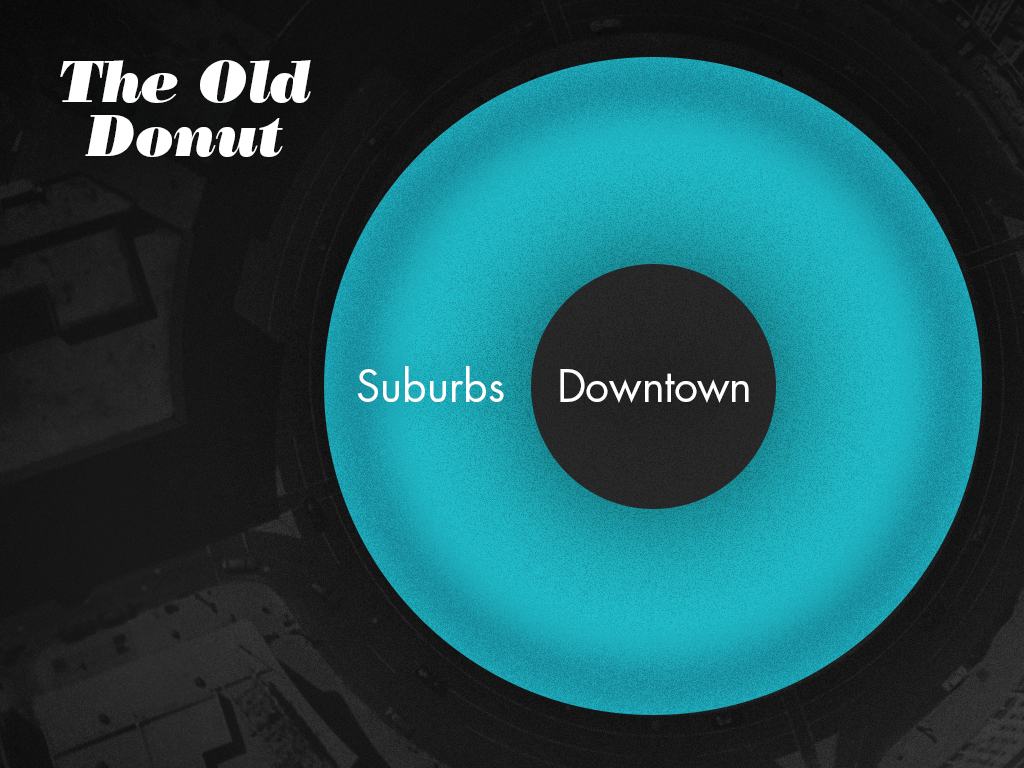
A few weeks ago on Urbanophile Aaron Renn discussed a historical concept of urban development known as the "donut" model. This concept takes place when a city's outlaying areas see more development than a city's urban core. This has historically been the development trend in many cities, including many rust belt cities like Detroit, Cleveland, Chicago, Saint Louis and Minneapolis, as well as some southern cities like Atlanta, and even here in Houston. European cities haven't been exempt to this pattern either.

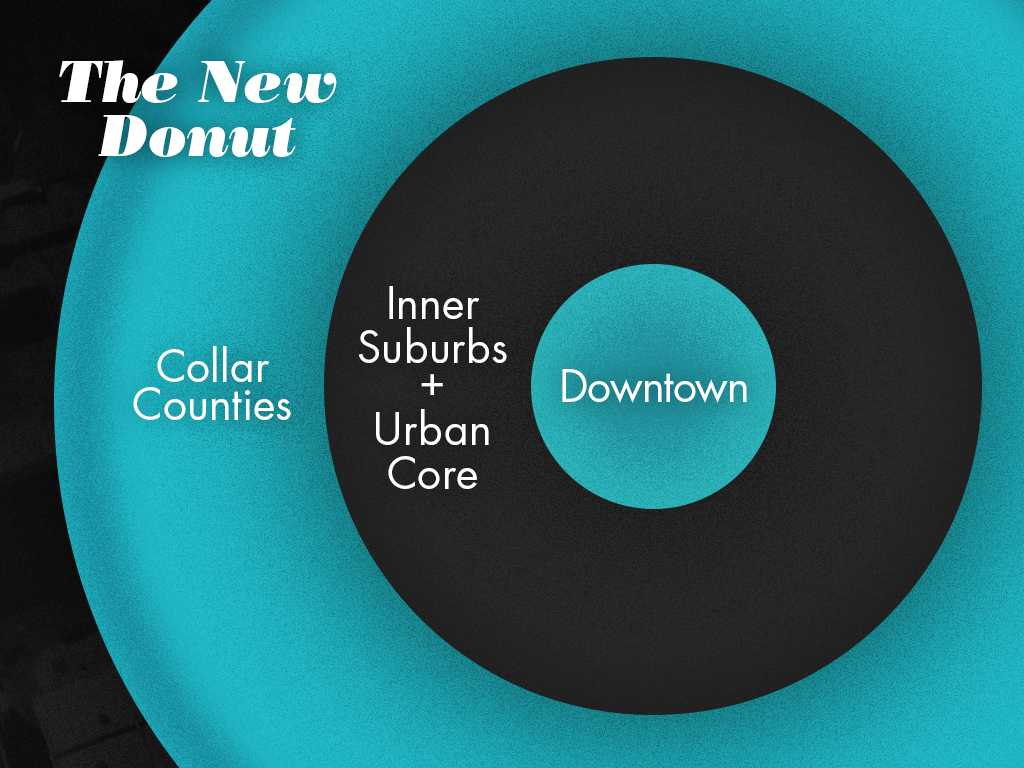
Renn then categorized the current development trend of many cities with gentrifying and revitalizing downtown districts, calling it the "new donut" paradigm. Some urbanists have attributed some of the effects of this new paradigm to the existence of traditional zoning in cities, claiming that existing zoning restraints effectively renders parts of cities unable to address the needs for increasing housing or development needs. As evidenced here in Houston, and recently in Minneapolis, among many other cities, Renn notes that:
Filling in the hole became every city’s mission. Pretty much any city or metro region of any size has pumped literally billions of dollars into its downtown in an attempt to revitalize them. This took many forms ranging from stadiums to convention centers to hotels to parking garages to streetcars to museums and more. It’s popular today to subsidize mixed use development with a heavy residential component.
Mmm, donuts. In Houston, when you discuss donuts, the topic rapidly shifts to Shipley's. It's Shipley's versus the rest of the world here, although Dunkin Donuts is making a push for a Houston presence. I'm not really sure how fried breakfast foods ended up being an analogy for discussing urban development, but they're both things I enjoy, so I don't mind it at all. And, since it's now fall, all this talk about donuts brings back the memories of Blakes Cider Mill in Armada, Michigan, sitting in the middle of an apple orchard, chowing down on freshly fried donuts washed down by fresh-pressed apple cider.

Courtesy of Urbanophile.com
While I love donuts, I like bagels too. Houston's development, and the downtown development in many cities, is more like the experience of having a cinnamon crunch bagel at Panera, which one can argue is much like a donut anyways. You know the bagel has a hole in it somewhere. It's just filled in with sweet, cinnamon-y toasted sugar. You know the hole is there in the middle of the doughy periphery, it's just filled in. Maybe that toasted cinnamon sugar filling is the gigantic amount of sweet public funding that cities have dedicated to building these stadiums, convention centers, and even residential developments. It's not at all that these attempts are wrong, but we've just invested a lot of taxpayer money in them. More to follow on residential development, specifically here in Houston, in the coming week or so.

Courtesy of Urbanophile.com
Okay, back to cities now. This "new donut" paradigm is precisely what has happened recently in Houston. The Astrodome was replaced with Minute Maid Park. It's only fitting that in a discussion about cities and breakfast foods, that we have a stadium named for a brand of orange juice. There's not much that we can thank former Enron Chairman Kenneth Lay for, other than his insistence that the Astros establish a downtown field, ultimately incorporating the former Union Station into the stadium's design. The Rockets then moved from The Summit to the Toyota Center, the George R Brown Convention Center was built, along with many hotels, parks and offices.

Thursday, August 28, 2014

Houston: The Adolescent City


Recently, people have struggled to describe Houston, to give it an identity.

We've got a new slogan that touts Houston's endless possibilities, but that can also evoke thoughts of our seemingly endless suburban sprawl. Houston used to be "Space City, USA", but now the space program faces colossal cutbacks. We still house NASA's Lyndon B. Johnson Space Center, but its role has been cut back drastically.

Houston used to be more widely known as "Clutch City", a description of the dramatic fashion in which the Houston Rockets won their 1994 and 1995 NBA Championships. But, the Rockets haven't been the same team since, so that one's lost its descriptive luster.

Houston's also known as the "Bayou City". And, even though Houston was founded on the banks of the confluence of White Oak and Buffalo bayous at Allen's Landing, it hasn't been until recently that the city or its citizens have understood the value of the city's bayous. They've got much greater value than simply being utilized as channels to collect the runoff from our suburban sprawl.

In the 1900's we were once named "The Magnolia City", but many of our magnolia trees were plowed under as our city grew.  Our oil economy afforded us the name "The Capital of the Sunbelt" in the 1970's. Due to our mass of oil and gas companies, we're also known by some as the "Energy Capital of the World."

Culturally, Houston has been called "H-Town". Hip hop and rap music fans know our city as "Screwston", in tribute to DJ Screw's "Chopped and Screwed" style.

The city of Houston's seal was influenced by our railroad heritage, but that seems to be something long forgotten. We've got no nickname for our history in that arena, and our utilization of rail in our city leaves us on the other side of the tracks of our heritage, and when compared to other large US cities. We've also imitated the moves of a bunch of other peer cities, and took out some pretty neat street car systems.

Houston has always done its own thing and wanted to doing things "uniquely Houston", whatever that is supposed to mean.That's why we might be best suited to call Houston "The Adolescent City".