Showing posts with label Downtown. Show all posts

Wednesday, November 19, 2014

Looking Forward to the Texas Big Six 2040: Potential Discussion Topics

This Friday city planning and development leaders from Texas' largest cities will gather at Texas Southern University for a day-long workshop and panel discussion to discuss each city's plans, policies and projects that will continue to "shape the livability, resiliency, and competitiveness" of each city and their surrounding regions. It will be the first time that all six of these directors has gathered to talk about development each of Texas' largest cities.

I wrote some thoughts two weeks ago about the benefit of this type of event, especially for a city like Houston. This week I'd like to explore some of the things that we might hear about from each city. Even though each city has different development circumstances, economic backgrounds, populations and governmental controls, we can still learn from each of them. So, planning and development issues what might we hear about from each of Texas' largest cities on Friday?

Houston

Houston is embarking on developing a General Plan. Perhaps we will hear more about the plan's progress, as well as the review of the city's Historic Preservation Ordinance. And, in a city without zoning, some might wonder what land use and development regulations the city and its citizens actually has at their disposal. 

Dallas

We might hear about Dallas' continued development in its downtown, and may be able to learn more about how the city uses Historic Districts and Conservation Districts top provide for community planning. We might also hear more about the decisions Dallas faces in zoning areas of the city for continued infill development and growth, including the city's recent review of the Oak Cliff neighborhood, just to the southwest of Downtown Dallas.

San Antonio

San Antonio may be able to discuss the continued growth of its neighborhoods, including the amending of its area plans, as well as the growth outside of the city's limits. We might also hear about how water accessibility has a role in development in San Antonio.

Austin

Austin may be able to tell us about what might lay ahead for the city after the failure of a proposed light rail expansion. More importantly, Austin may give us an update on the efforts the city is making in their CodeNEXT initiative. It's an attempt to "simplify the development rules but find ways to fit more housing and development in the city’s core, especially along major roads." This is something Houston might be able to learn from, as Austin seems to be allowing itself to accommodate a greater amount of infill development as the city grows in population. We also might be able to hear more about Austin's continued interest in learning more about tiny homes and micro-units.

Fort Worth

Fort Worth may be able to shed some light on its town and gown relationship with TCU, especially given the recent halt on single family housing permits surrounding the TCU campus. Fort Worth is also considering raising the minimum parking requirements for single family dwellings around the TCU campus, assuming that parking for rental homes is leading to an increase in street parking. The city is also in the process of adding parkland through the city's 2015 Parks, Recreation and Open Spaces Master Plan. Even though it is not a plan developed by the Planning and Development Department, it is an important planning topic, especially in a growing city. (City of Fort Worth Parks and Community Services survey).

El Paso

El Paso might be able to tell us more about its recently launched Bus Rapid Transit (BRT) line, the Sun Metro Brio, as well as the continued development of El Paso's downtown.

These are all speculative topics that we might hear about from each city. There will be a time for questions and answers, so if these topics, or others of the public's interest, aren't answered in each director's presentation, there's a time to ask them.

More information about the event can be found on the Houston APA website, and if you're interested in attending you can sign up to attend the event here.


Fri, Nov. 21, 2014
8:30 a.m. - 3:30 p.m.
Houston, Texas


Thursday, November 13, 2014

Caring About the Transit User Experience in Houston


I ride the local bus to and from work nearly every day, and I have to admit, I love it. When I tell people this, they usually give a second look. For me, it’s relative freedom from the grips of the morning gridlock. I can sit back, read and take in the cityscape. Stepping into a packed local bus gives a glimpse into Houston’s diverse population. Is there a better place to see the full spectrum of human nature on display than a confined space with 30 other strangers as you zip through the city?

No matter our age, profession or economic status, we need to get from one place to another. All of us want that experience to be as pleasant and safe as possible. Like urbanist blogger Daniel Kay Hertz said a few weeks ago, “Buses: They don’t have to suck.” Hertz focuses his recommendations on bus technology in Chicago such as all-door-boarding, bus pre-payment, or dedicated roadway lanes for public transit. In Houston, we might be best served to look at our ridership experience more holistically and focus on conditions in the pedestrian realm. The same applies here in Houston. Riding and waiting for the bus doesn't have to suck.

In transit, the most important issue for riders is likely the frequency and path of service.  If a service doesn't run frequently enough or is not direct enough, it's likely someone would simply drive a car. METRO will roll out their reimagined bus system next year, hopefully allowing more opportunities for ridership. We may allow more people to have access to our system, but will people use it? Will they feel comfortable using the system? What will the user experience tell someone about METRO or Houston? Will new riders give transit a try, and will long-time riders continue to support our system?

Wednesday, October 8, 2014

Downtown Houston, Families and Residential Development

It's easy to be excited about the increase of multifamily housing developments in Downtown Houston. They're popping up all over the place. They're announcing new projects weekly. I hesitate to call all these developments multifamily, as most of these units are not likely accommodate families, but instead high-income singles, couples, or roommates. Take some time for yourself and examine the most recent 2008-2012 American Community Survey (ACS) 5-year estimates on the American FactFinder site for US Census Tracts 1000 (most of Downtown Houston) and 2101 (the part of Downtown Houston north of Buffalo and White Oak Bayous and south of I-10). The ACS population numbers for Downtown Houston are probably much lower than current conditions when considering the growth that has taken place in Houston. However, the trends revealed are valuable. It may be more trustworthy to look at more recent retail analyses when inquiring about more recent population numbers. 

Investment, especially in residential properties, is a great thing for Downtown Houston. Keep it coming! We need more residential investment,
especially as we continue to attempt to attract retail and entertainment opportunities. If retail and entertainment establishments are to be viable, Houston needs more residents near its core, or people need to see Downtown Houston as a destination. Right now, both of those realities are relatively weak when compared to other cities, but they are getting stronger.

To boost Downtown Houston's residency, in 2012 the Houston Downtown Management District and the TIRZ#3 Downtown Living Program of the Downtown Redevelopment Authority partnered to create the Downtown Living Initiative Program. The program provides development incentives for multifamily and mixed use developments that construct more than 10 new dwelling units, are within the program boundary area, and help to enhance the pedestrian environment. The program was originally intended to provide incentives for 2,500 units, but was expanded to provide incentives for up to 5,000 units total. Developers can take advantage of the program until June 30, 2016, or until all 5,000 units are accounted for. With a dozen residential projects either completed or scheduled, more than 3,800 of the 5,000 units are accounted for. The funding of up to $75 million is not a small amount of money.

If you take notice of what is happening in most large cities, and especially in North America, people, especially millennials, want to live in cities, especially urban cores. To many Houstonians, this doesn't make sense. Many claim that people move to Houston because they want a single family home with a large yard, which they can drive to in their air conditioned car. Urbanism? We don't need no stinkin' urbanism. People want suburbanism! But yet, there's those that argue against the "Keep Houston, Houston" position, claiming our recent parks and urban development progress as making this city a better place to live. The juxtaposition of these views is what keeps Houston from really making meaningful changes in how things look on the ground here, and how the city operates as an organism.

Wednesday, September 24, 2014

Houston, Zoning & the New Donut Model

Mmm, donuts.
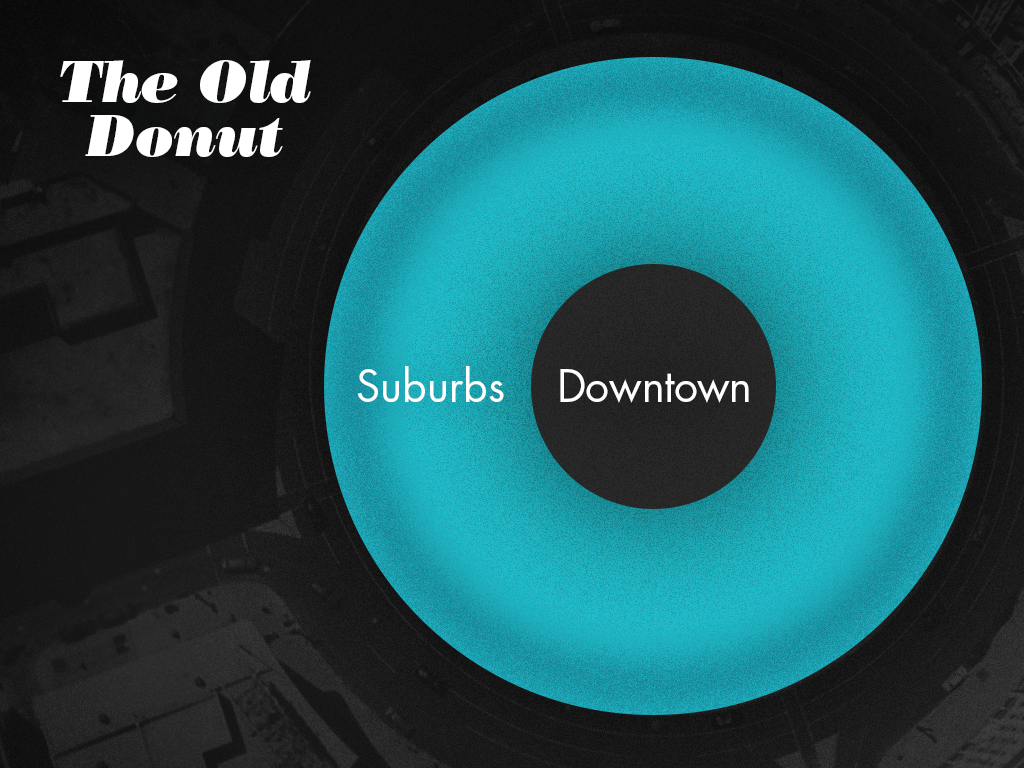
A few weeks ago on Urbanophile Aaron Renn discussed a historical concept of urban development known as the "donut" model. This concept takes place when a city's outlaying areas see more development than a city's urban core. This has historically been the development trend in many cities, including many rust belt cities like Detroit, Cleveland, Chicago, Saint Louis and Minneapolis, as well as some southern cities like Atlanta, and even here in Houston. European cities haven't been exempt to this pattern either.

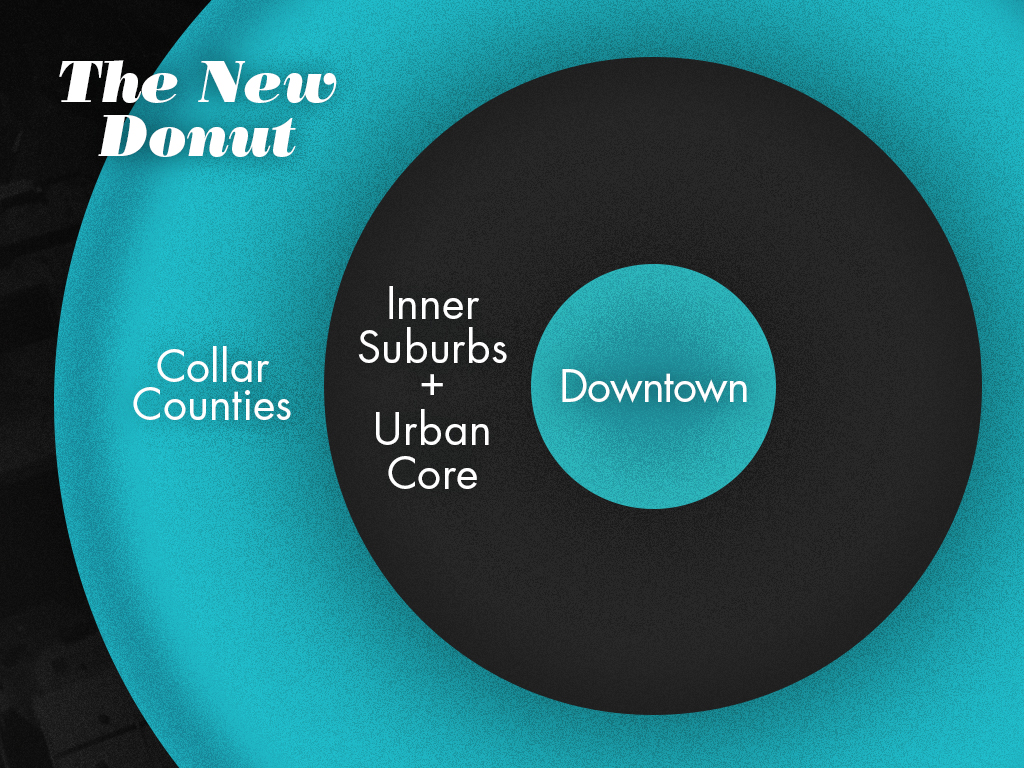
Renn then categorized the current development trend of many cities with gentrifying and revitalizing downtown districts, calling it the "new donut" paradigm. Some urbanists have attributed some of the effects of this new paradigm to the existence of traditional zoning in cities, claiming that existing zoning restraints effectively renders parts of cities unable to address the needs for increasing housing or development needs. As evidenced here in Houston, and recently in Minneapolis, among many other cities, Renn notes that:
Filling in the hole became every city’s mission. Pretty much any city or metro region of any size has pumped literally billions of dollars into its downtown in an attempt to revitalize them. This took many forms ranging from stadiums to convention centers to hotels to parking garages to streetcars to museums and more. It’s popular today to subsidize mixed use development with a heavy residential component.
Mmm, donuts. In Houston, when you discuss donuts, the topic rapidly shifts to Shipley's. It's Shipley's versus the rest of the world here, although Dunkin Donuts is making a push for a Houston presence. I'm not really sure how fried breakfast foods ended up being an analogy for discussing urban development, but they're both things I enjoy, so I don't mind it at all. And, since it's now fall, all this talk about donuts brings back the memories of Blakes Cider Mill in Armada, Michigan, sitting in the middle of an apple orchard, chowing down on freshly fried donuts washed down by fresh-pressed apple cider.

Courtesy of Urbanophile.com
While I love donuts, I like bagels too. Houston's development, and the downtown development in many cities, is more like the experience of having a cinnamon crunch bagel at Panera, which one can argue is much like a donut anyways. You know the bagel has a hole in it somewhere. It's just filled in with sweet, cinnamon-y toasted sugar. You know the hole is there in the middle of the doughy periphery, it's just filled in. Maybe that toasted cinnamon sugar filling is the gigantic amount of sweet public funding that cities have dedicated to building these stadiums, convention centers, and even residential developments. It's not at all that these attempts are wrong, but we've just invested a lot of taxpayer money in them. More to follow on residential development, specifically here in Houston, in the coming week or so.

Courtesy of Urbanophile.com
Okay, back to cities now. This "new donut" paradigm is precisely what has happened recently in Houston. The Astrodome was replaced with Minute Maid Park. It's only fitting that in a discussion about cities and breakfast foods, that we have a stadium named for a brand of orange juice. There's not much that we can thank former Enron Chairman Kenneth Lay for, other than his insistence that the Astros establish a downtown field, ultimately incorporating the former Union Station into the stadium's design. The Rockets then moved from The Summit to the Toyota Center, the George R Brown Convention Center was built, along with many hotels, parks and offices.

Tuesday, September 2, 2014

Parkitecture: Surface Parking Lots in Downtown Houston - Pay Stations, Honesty Boxes and Parking Huts

***Update: Portions of my post were featured in the Gray Matters column on the Houston Chronicle website on September 3, 2014.


Houston is a city of commodities. In order of importance, parking ranks a close second right behind oil. We love our cars, and Houstontians need somewhere to store them when they drive themselves to work. Roughly 57 percent of all Downtown Houston workers drive alone to work, so that means there's a great number of cars that need parking spaces on any given work day. Some estimates have almost 22 percent of Downtown Houston being covered with surface parking, and almost another 4 percent covered by parking garages. These numbers have fluctuated somewhat in the past few years, but are probably still somewhat close. Just take a look at Downtown Houston's parking map to make an estimate yourself. It's been a long standing position of urbanists that American cities are haunted by too many parking spaces, leaving productive land underutilized. Parking lots have become the scourge of our downtowns. Streetsblog even documented some of our country's biggest urban parking craters, labeling them cancers to downtown districts.


Surface parking is something that is a convenience in Houston, even in our downtown. It's far too easy to find parking in Houston. We have to remember though, we're not entitled to easy and abundant parking access. Our parking situation is extremely different than most of the world-class cities to which we compare ourselves economically, like New York or Chicago.